

Recent investigations and lawsuits involving residential solar companies and lenders are drawing attention to a familiar pattern: homeowners being told one story during the sales process and discovering a very different financial or practical reality after signing. Allegations raised by regulators include overstated savings, misleading tax-credit claims, hidden financing costs, defective systems, incomplete installations, and loan payments that continue even when the solar project has serious problems.
These enforcement actions do not automatically invalidate anyone else’s solar contract. They do, however, show why homeowners should compare the sales pitch, signed agreements, financing documents, system performance, and current bills before deciding what to do next.

Why Solar Sales Practices Are Receiving More Attention
Residential solar transactions can involve more than one company. A homeowner may deal with a salesperson, solar dealer, installer, lender, loan servicer, equipment manufacturer, and warranty provider during a single project.
That structure can create confusion when something goes wrong. The company that made the promises may not be the company collecting the payments. The installer may be different from the dealer named in the proposal. The lender may continue billing the homeowner even when installation, activation, production, or service problems remain unresolved.
Recent government actions in Texas and New York illustrate how these different parts of a solar transaction can overlap.
Texas Investigation Focuses on Savings, Performance, and Contracts
In April 2026, the Texas Attorney General announced an investigation into the residential sales practices of several solar companies. The office said it had received more than 100 complaints involving the companies under investigation.
According to the announcement, the complaints raised concerns involving:
- Claims about energy-bill savings
- Solar system effectiveness
- Equipment and installation quality
- Warranty and service terms
- Marketing practices
- Contract information
The investigation sought information about how the companies calculated projected savings, tracked actual savings, presented warranties and service plans, and marketed their agreements to homeowners.
In May 2026, the Texas Attorney General also filed a lawsuit against CAM Solar. The state alleges that the company used fraudulent and deceptive practices when selling residential solar systems.
The Texas Attorney General’s announcement describes allegations involving systems that produced significantly reduced or nonexistent savings, defective or nonfunctioning equipment, improper installations, unanswered service requests, undisclosed fees, tax-credit representations, and continuing financing obligations.
These claims are allegations in an ongoing legal matter. Filing a lawsuit does not establish that every allegation has been proven, and the final outcome may depend on future court proceedings.
New York Case Includes the Solar Company and Financing Partners
In March 2026, the New York Attorney General filed a separate case involving solar company Attyx, formerly known as SUNco, company executives, and lending partners Solar Mosaic and WebBank.
The state alleges that consumers were promised free or heavily subsidized solar systems, roof repairs, and related home improvements through government incentives. According to the attorney general, some homeowners were instead placed into expensive sales and financing agreements.
The New York Attorney General’s announcement includes allegations that:
- Government incentives were presented as covering most or all project costs
- Solar systems were promoted as substantially reducing electric bills
- Some homeowners could not use the tax-credit amounts presented during the sale
- Some consumers believed they were signing applications or credit-check forms rather than binding agreements
- Lender fees were allegedly included within inflated project prices
- The complete financing cost was not clearly explained
New York is seeking restitution, civil penalties, and an order voiding the agreements involved in the case. Those are remedies requested by the state, not outcomes that have already been awarded or that automatically apply to other solar customers.
Federal Agencies Previously Warned About Similar Problems
The recent state actions follow earlier warnings from federal regulators. In August 2024, the U.S. Department of the Treasury, Consumer Financial Protection Bureau, and Federal Trade Commission announced a coordinated effort addressing unfair and deceptive conduct in the residential solar market.
The agencies cited complaints involving high-pressure sales tactics, unfair financing, incomplete installations, systems that were not activated as promised, and other practices that could leave homeowners with expensive obligations.
The Treasury announcement also provided consumer resources explaining common solar arrangements, questions to ask, warning signs to review, and ways to report potential misconduct.
Five Areas Homeowners Should Compare
The most useful takeaway from these cases is not that every unhappy solar customer has the same claim. It is that several parts of a solar transaction should be compared side by side when the outcome does not match the original pitch.
1. The Sales Proposal and the Final Contract
The proposal may show estimated savings, expected production, tax incentives, monthly payments, and a projected return over time. The final contract may contain qualifications, limitations, payment conditions, transfer provisions, and dispute terms that were not emphasized during the presentation.
Compare:
- The system price shown in the proposal
- The price stated in the signed contract
- The amount financed
- The monthly payment presented by the salesperson
- The payment schedule in the loan, lease, or PPA
- Any promised savings or production estimates
- Any disclaimers attached to those estimates
A difference between the sales conversation and the written documents is one of the most important bad solar contract red flags to review.
2. The Cash Price and the Amount Financed
Some homeowners focus on the monthly payment and do not realize how much the total financed amount differs from the apparent cash price of the system. Financing costs or dealer fees may be built into the project price rather than listed as a separate charge.
Review the documents for:
- Cash purchase price
- Total financed amount
- Interest rate and annual percentage rate
- Finance charges
- Loan duration
- Total of all scheduled payments
- Prepayment terms
- Dealer or lender fees
If the loan itself is the main concern, review what to check before trying to cancel a solar loan and the broader information available on the solar payment issues page.
3. Tax-Credit Promises and Payment Assumptions
A federal tax credit is not necessarily an automatic rebate, guaranteed refund, or direct payment from the government. Eligibility and the ability to use a credit can depend on the tax rules in effect, system ownership, installation timing, tax liability, and individual circumstances.
Some solar financing structures also assume that the homeowner will make a lump-sum principal payment after receiving or claiming a tax credit. If that payment is not made, the monthly loan payment may increase.
Look for terms such as:
- Re-amortization
- Principal reduction
- Promotional payment period
- Tax-credit payment
- Expected voluntary payment
- Payment adjustment date
If the tax credit was a major part of the sales pitch, review what to check when you were promised the 30% solar tax credit.
DitchYourSolar does not provide tax advice. A qualified tax professional should evaluate whether a homeowner qualified for a particular credit and how it applied to an individual tax return.
4. Projected Savings and Actual Household Costs
A sales proposal may compare the expected solar payment against a homeowner’s previous utility bill. That comparison can become misleading if it does not account for the remaining electric bill, fixed utility charges, changing household usage, system underproduction, rate-plan changes, or increasing lease and PPA payments.
Compare the following numbers:
- Average utility bill before solar
- Current utility bill after solar
- Monthly solar loan, lease, or PPA payment
- Total monthly energy cost
- Estimated system production
- Actual system production
- Any annual payment increase
If you still receive a substantial utility bill, the guide on having a high electric bill with solar panels can help identify the numbers and records worth checking.
5. Installation, Activation, Warranty, and Service Records
Financial terms are only part of the review. Some disputes begin because a system was never completed, activated, connected to the utility, or repaired after a reported problem.
Gather records showing:
- Installation dates
- Permit and inspection status
- Utility interconnection
- Permission to operate
- Monitoring access
- Production history
- Service requests
- Warranty claims
- Company responses
- Photos of incomplete work or property damage
Also identify which company was responsible for each part of the project. The seller, dealer, installer, lender, servicer, and warranty provider may all have different responsibilities.
Why a Solar Problem Does Not Automatically Cancel the Loan
A common source of frustration is continuing to receive loan statements while the system is not operating correctly or the installer is no longer responding.
The installation agreement and financing agreement may be separate contracts. A dispute with the installer does not necessarily stop the lender from collecting payments under the loan. Similarly, an investigation, lawsuit, business closure, or bankruptcy does not automatically terminate every customer agreement.
Do not stop making payments solely because another homeowner filed a complaint or a regulator announced a case. Missed payments may lead to late fees, collection activity, credit reporting, or other consequences.
That does not mean unresolved installation or sales problems should be ignored. It means the contract, financing terms, evidence, and available solar contract exit options should be reviewed before taking action.
Build a Complete Solar Contract File
Regulatory cases often depend heavily on documentation. Homeowners should take the same practical approach when reviewing their own situations.
Create one file containing:
- Signed solar contract or installation agreement
- Solar loan, lease, or power purchase agreement
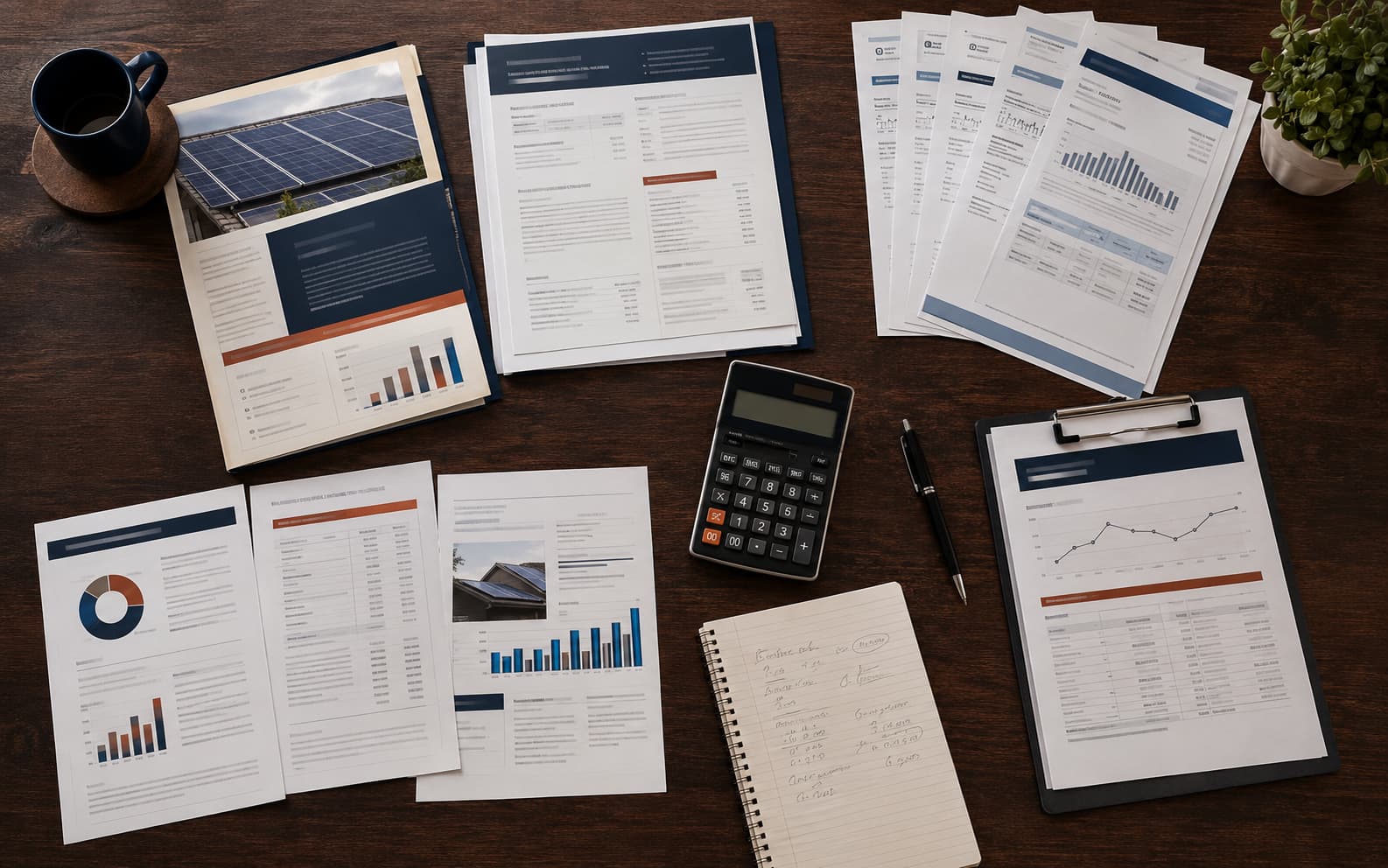
- Sales proposal and savings estimate
- Payment schedule and lender disclosures
- Tax-credit estimates or representations
- Utility bills from before and after installation
- Solar payment statements
- System design and production estimates
- Monitoring screenshots or production reports
- Warranty documents
- Permit, inspection, and interconnection records
- Service requests and responses
- Texts, emails, advertisements, or sales notes
- Photos of installation or property problems
- Notices from the lender, servicer, or solar company
Organizing these materials makes it easier to determine whether the main concern involves the sales process, financing, tax-credit assumptions, payment pressure, system performance, service failures, or several issues at once.

What These Investigations Do Not Prove About Your Contract
Government enforcement actions can be important, but they should not be treated as automatic proof about a separate homeowner’s agreement.
- An investigation does not establish that every allegation is true
- A filed lawsuit is not the same as a final judgment
- Allegations against one company do not apply to every solar provider
- A disappointing financial outcome does not automatically establish fraud
- A system problem does not automatically eliminate financing obligations
- A remedy requested in court has not necessarily been granted
- Cancellation options depend on the agreement, evidence, timing, location, and individual facts
The better question is not whether another lawsuit automatically releases you from your agreement. The better question is whether your own documents show a mismatch, undisclosed term, unresolved obligation, or other issue that deserves a closer review.
Review the Agreement Before Deciding What to Do
If the solar deal you received does not match the deal you thought you signed, begin by identifying the exact point of disagreement.
For example:
- The projected savings never appeared
- The utility bill did not decrease as represented
- The financed amount is much higher than expected
- The payment increased after a tax-credit deadline
- The agreement contains an escalator that was not clearly explained
- The system was never activated or does not produce as expected
- Installation or property damage remains unresolved
- The installer stopped responding
- The lender continues billing despite project problems
- The contract contains terms that do not match the sales presentation
If you are still trying to determine whether getting out may be possible, read Can You Really Cancel a Solar Contract?
Start With a Solar Contract Review
Recent regulatory actions show why solar contracts should be evaluated as complete transactions rather than isolated monthly payments. The sales pitch, contract, loan, tax-credit assumptions, installation history, production, service records, and current bills can all affect the bigger picture.
DitchYourSolar helps homeowners review difficult solar agreements, identify important contract and financing issues, and better understand what options may be available.
Upload your solar contract and related documents for a free review.
You can also learn more about the solar contract review process or explore potential solar contract exit options.